The forests of Jharkhand are rich in a diversity of resources both in flora , fauna and natural minerals. But since the time of colonisation , these forests have been colonised by successive regimes who have been local and invading. It is in fact a land of continuous colonisation. The population who live in harmony with the forests are deemed ‘tribals’ or the more patronising moniker ‘ Adivasis’ – those inhabit in a past before civilization. Though they possess complex languages from the austro-asiatic family and a culture that is more sophisticated than the neighboring regions where society is divided on the strands of caste and colour hierarchy.
The British established a coal mining operation in the region of Dhanbad in year 1894, the coal was needed for running rails and produce steel. Dhanbad then became a town with rail networks and soon the lands were deforested and the local population grafted into the birth of Indian industrialisation. But the Santhals and Mundas who constituted the so called tribal or ‘adivasi’ population were seen as lazy or untamable by the British and Indian overseers and gangmen , thus able bodied men from the Gangetic plains of Uttar Pradesh and Bihar and other states in South India were lured into working the coalfields for the British and their businesses held by Indians who were patronised by the colonial administration. As the Santhals and the Mundas lost their local sources of sustenance in the forests and fields , they became dislocated not only from their livelihoods, but also their language and culture. They became ‘Adivasi Labour’ nomadic unskilled men to be used for wages less than the incoming immigrants and for jobs where they risked their life and health. The adivasis crafted a local patois : ‘Khortha’ a mixture of Maithili (Eastern Indic – Indo-European Language’) and Santhal words to communicate amongst themselves and the immigrants in places such as Dhanbad and Jamshedpur. Dhanbad etymologically means the city of wealth using Sanskrit (Dhan) and Persian (Abad). Jamshedpur is championed as India’s best run municipality and is named after the private entrepreneur Jamshedjee Tata who colonised the forests and created the city for his emigrated employees. The act of benevolence to ones staff can be violent to people who have had ancient rights over their forests.
Birender Yadav’s family arrived from Ballia in the neighboring state of Uttar Pradesh to Dhanbad to work in Coal mines. The migration was easy as then Dhanbad and the state of Jharkhand were part of Bihar which is a sister state of UP. Yadav’s father worked as the Blacksmith at the Colliery and often needed diagrams to create instruments needed in the excavation of coal. He would encourage his son to draw him diagrams and design the lines of the casting for his instruments. As Birender turned 15 , his father decided he should pursue a study in Fine Arts so that he could return to Dhanbad and begin a family business in forging instruments. He was sent to Banaras , better known as Varanasi , and here he studied for his 0 & A Levels and soon graduated with a Bachelor of Fine Arts from the Banaras Hindu University.
A great deal of patience and observation went into the production of a series of objects, sculptures, paintings and photographs that are to be part of a complex solo exhibition by Birender Yadav that not only reveal the studio practice of an artist but also long thought out visual commentary on dislocation. During a residency at 1 Shanthi Road , Bangalore , Yadav saw the affinities of colour between a packet of matches and the propositions for a flag that was to be adopted by the Karnataka State, as a provincial drapeau . Here he began to draw the Kannada script which is distinct from his mother tongue and a different family from his own script. Earlier on he had drawn words in Oriya , a script from the east in India that read black letter, but a script he could not read. When you are illiterate in India we have saying ‘ If you can’t read , Black letters are as good as a black buffalo! ” Birender wrote this in a script he could not read. Another proverb used the traditions of carpentry in Orissa used for making temple statues where he carved in the oriya script on a log of wood a popular Indian proverb that can be used for masturbation and hardwork ” A hand is capable to create the wonders of the world” .
Birender Yadav one day while at school in Benaras or Varanasi came across of men called the Jahrkhandi men colloquially. These were men brought to a town in the outskirts of Varanasi called Mirzapur , here they toiled night and day in brick kilns. Birender had recognised them from the Khortha language they spoke, the patois used in Dhanbad between the indigenous people and the settlers. Yadav soon realised huge gangs of indigenous Santhals and Mundas are trafficked across India to work in construction and brick kilns. Yadav began to document their presence in the region which was coincidently also the region from where his family had migrated Dhanbad. He was surprised by the twist in the tale how his family had migrated to escape poverty to Jharkhand and they had dsiplaced its indigenous population into dislocated precariousness. He began to take their fingerprints as forms of a drawings. They were unable to write or sign in their names. Their identity lay in it being taken away from them through political and economic war. They stamped their thumbs onto faces as they did for government forms obscuring their portraits. Instead Yadav drew them in ink enlarging their thumbprints onto large scale. The result is a tragic comedy of visuals, a painful still humourous satire of loss and an artists efforts to narrate the ugliest picture of coal mining.
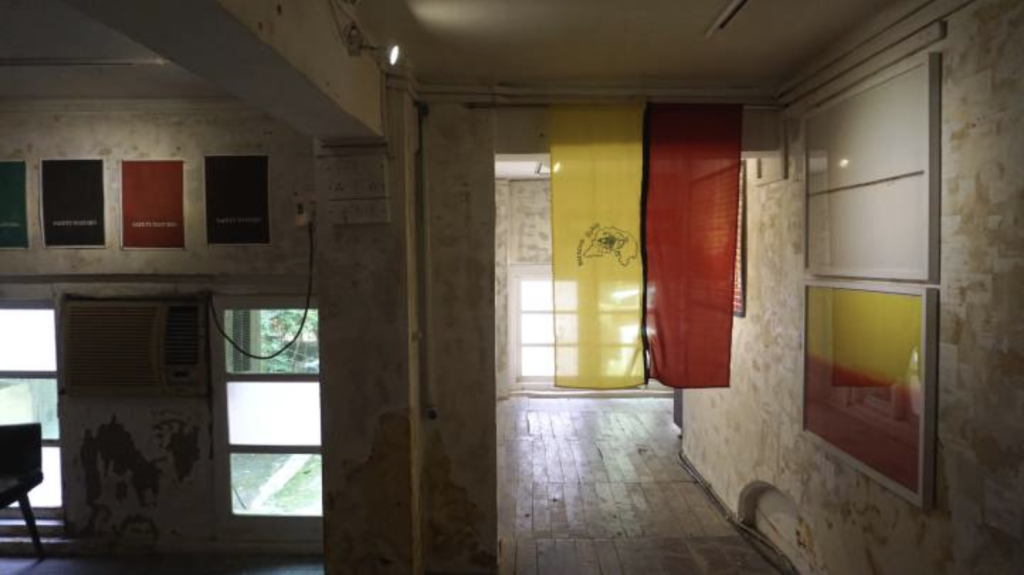
Yadav earlier this year was on a residency at the 1 Shanthi Road Bangalore. When he reached the city found a certain comical agitation for a state flag that had been heard of in India except in the state of Jammu & Kashmir. Parochialism, Regional and Linguistic Nationalism plagues many parts of India. It is most prevalent in states where it becomes a rallying point against federalism. The Indian National Congress a secular federationist party to prevent the deluge of populist fascism has begun to play the politics of language and flags in the state of Karnataka. Whilst there Birender saw a packet of matches that held the same colours of the flag of Karnataka – Yellow and Red. He rubbed off the red combustible dust on the matchbox and painted a flag using turmeric (also an antiseptic) for yellow and the rubbings from matchboxes for the deep red. In another work he divided the yellow and red flag by a simple zip. Then painting the farmer also depicted on the matchbox as a social message, he began to right the word ‘kisan’ or farmer in white onto the various hues of the flags of Indian political parties. Commenting on their failures to deliver on social justice and equity but their obsession to use sloganeering and design to gather crowds. He changes to delicate watercolour the graphic of a one rupee steel coin that reads ‘ Food for All’.
An amalgamation of studied objects, paintings and videos build an exhibition that is not a visit to an artist studio. To prepare for his solo at Clark House , Birender went back to Varanasi and established the ‘Studio Banaras’ in his 150 square foot tenement he used as his studio and living place during his time in Banaras as a student. Indian Universities have failed their students for the past many decades, their duty towards education is lost. Birender migrated to Delhi to become an artist, his dislocation is very personal because it adds onto to him many identities. We hardly talk of the internal diasporas of India that have been created by desperate poverty, violence, job opportunities and dislocation for mines, industries and real estate. Birender a child of the diaspora uses language to express his angst against this constant change and movement , the fact people are debased into becoming industrial inputs, he goes back to speak for those who his own family displaced through migration. A conceptual artist he uses various elements from painting to sculpture to process his ideas and questions. This becomes a show of many voices from the subaltern. At Clark House we have not recently read about the subalterns , but as Gormati – Romani artist Shiva Gor said , the subalterns are speaking , infact loudly, but who is listening? A show called ‘We are here because you are there’ at the Project room at Clark House Initiative as the same time as time as Birender Yadav’s solo in the exhibition space deals with an context that is the crux of Birender’s investigation in labour and its rights.
-Sumesh Sharma
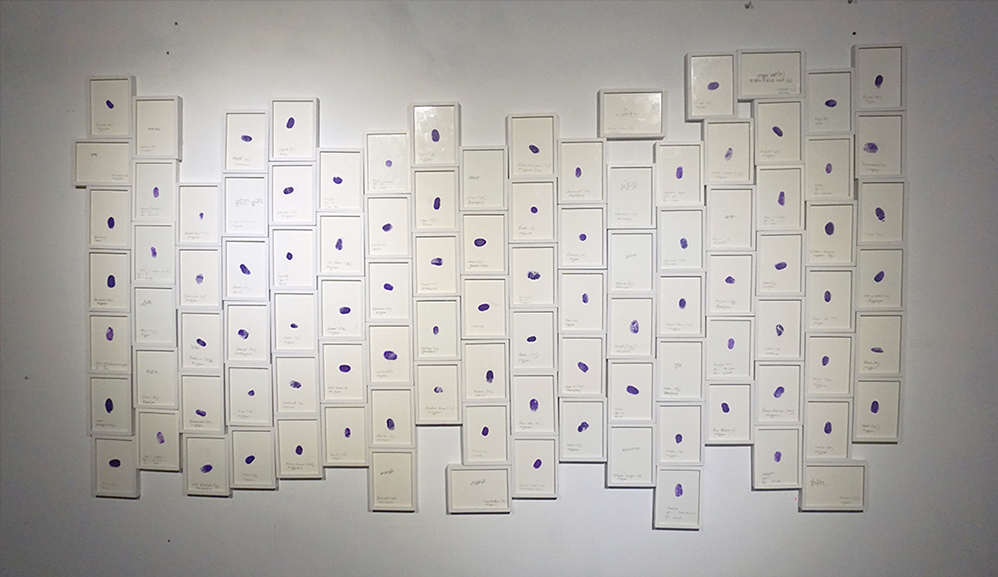
“Angootha Chaap “, 2015 (Set of 101)
Actual thumb print of works | 12.70 × 10.16 cm each
Among other things, Birender Yadav has been exploring his identity as a son of a coal miner from Dhanbad. In one of his previous works, he used workers’ thumb prints as impressions of the uneducated – a process that engages people who work hard for a living.His work grapples with the self and his own predicament as an artist whose idea is to explore conceptual ideas about identity, material and the politics and violence that is prevalent in our society. His recent work, while he lived on Shanthi Road, looks at surveillance in Bengaluru, the iconic evil eye demons that dot the city, and the popular political symbols that fire his imagination.
Labour movements have often been an inspiration for artists, who are typically sympathetic to workers and their struggles. Official sources say that Dhanbad-Jharia coal fields form part of this heavy industrial triangle. They are a rural mining area, with about 110 official coal mines and probably the same amount of unofficial mines.
They are India’s main center for manufacturing coal used for cooking, a particular sort of coal important for steel production. Scattered in the region are the vast open-cast mines, interspersed with villages and miners colonies. Trucks loaded with coal and heavy machinery dominate the scenery, interrupted by push-carts and bicycles – loaded with coal. The Dhanbad-Jharia region is said to be one of the most polluted areas of the world.
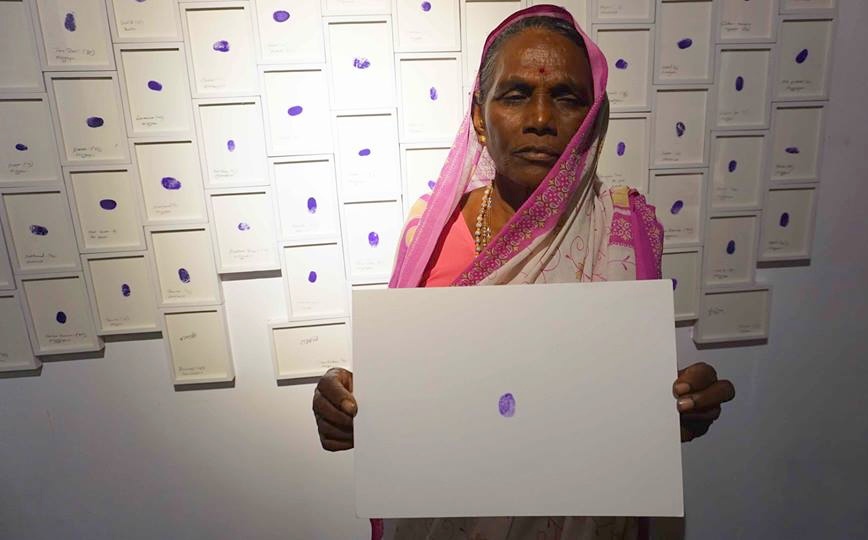
Birendra’s work is mature and suggestive and he has been very clear about his intentions. His work is more a conceptual idea distilled from a living reality. The series of finger prints of workers is a poignant work and explores the word “anguta chaap”- the thumb impression being a sign of the uneducated masses. In resent times, it has achieved a new status in the form of bio-metrics and the “aadhar card”, a national identity card that stores details of the citizen.The fears of information being misused has been a constant concern.
The city of Bengaluru was a new site for Birendra at the art residency,the most common objects and symbols became a trigger to investigate. was a take on the popular red and yellow Karnataka flag and the growing regional nationalism in the state. The colors of the flag represent turmeric yellow and Kum Kum red. It emerged in the context fight for Kannada pride and identity by locals to safe guard their rights. Local Kannada groups have used it extensively to celebrate Kannada Rajotsava.
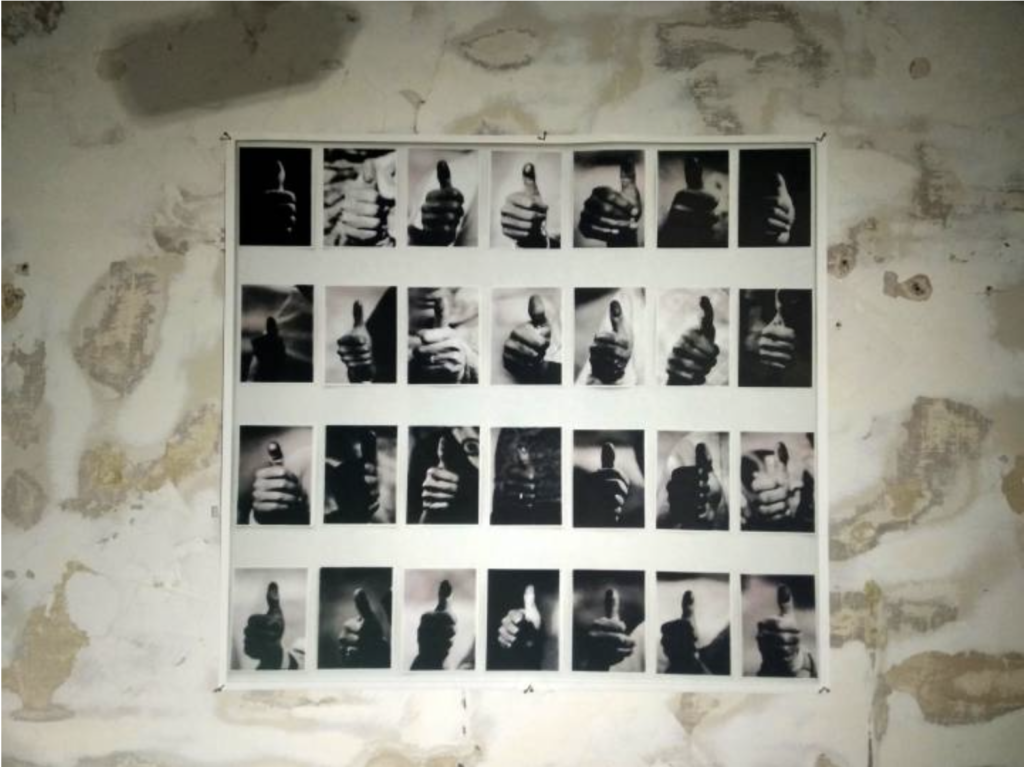
“Thumbs Up”, 2015 (Set of 28)
Archival print | 29 × 21 cm (each)
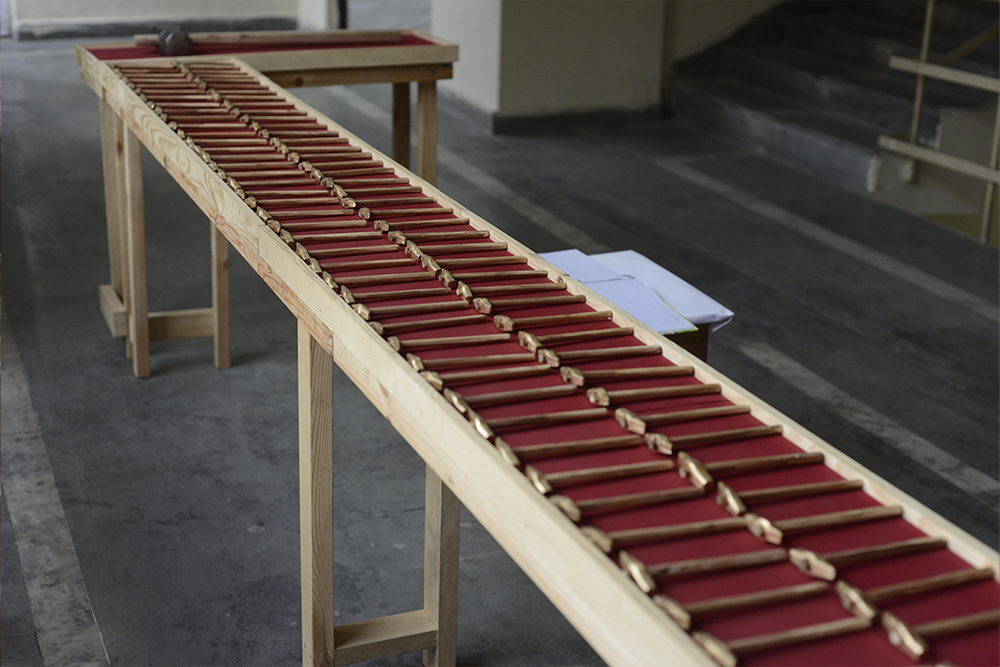

101 Acts of Making, 2015
101 handmade iron hammers forged by my father | 365.8 × 30.5 × 76.2 cm and 91.4 × 30.5 × 76.2 cm (12 ft × 1 ft × 2.5 ft and 3 ft × 1 ft × 2.5 ft)
One large machine-cast hammer is displayed alongside one hundred hammers forged by hand by my father. While the machine can reproduce the same form repeatedly with precision, each handmade hammer bears subtle variations shaped by heat, skill, bodily labour, and the unpredictability of manual production. These differences reveal the presence of the maker and make visible what industrial standardization often seeks to eliminate: human error. Rather than being imperfections, these variations become records of touch, time, and labour. The work reflects on the tension between mechanical repetition and the individuality embedded in handmade production, questioning what is gained and what is lost when making shifts from the human hand to the machine.
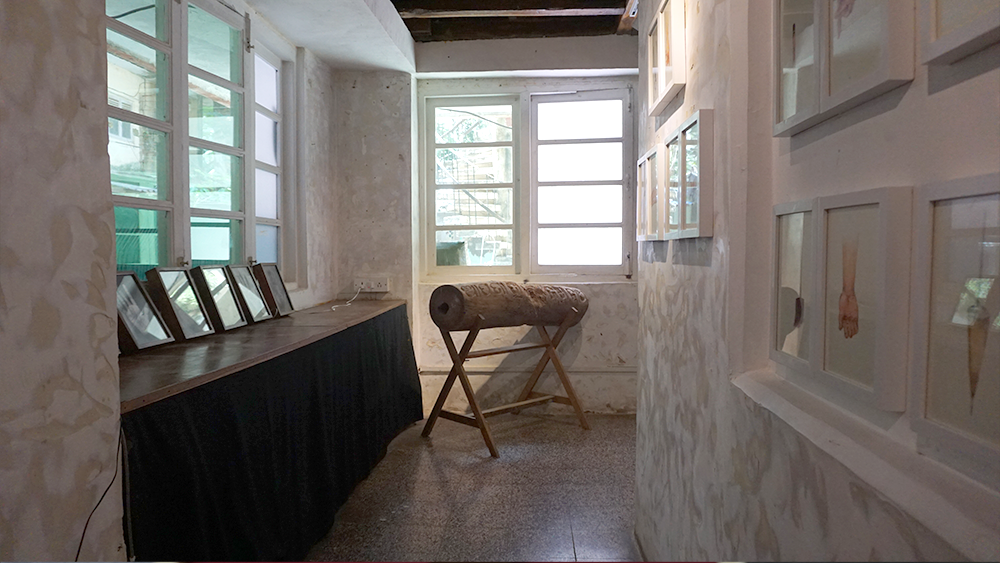

“One’s own hands are one’s greatest support”, 2017
Wood | 106.7 × 30.5 × 25.4 cm


Between Red and Black, 2017 (set of 2)
Gun powder extracted from matchsticks on paper | 56 x 76 cm (each)
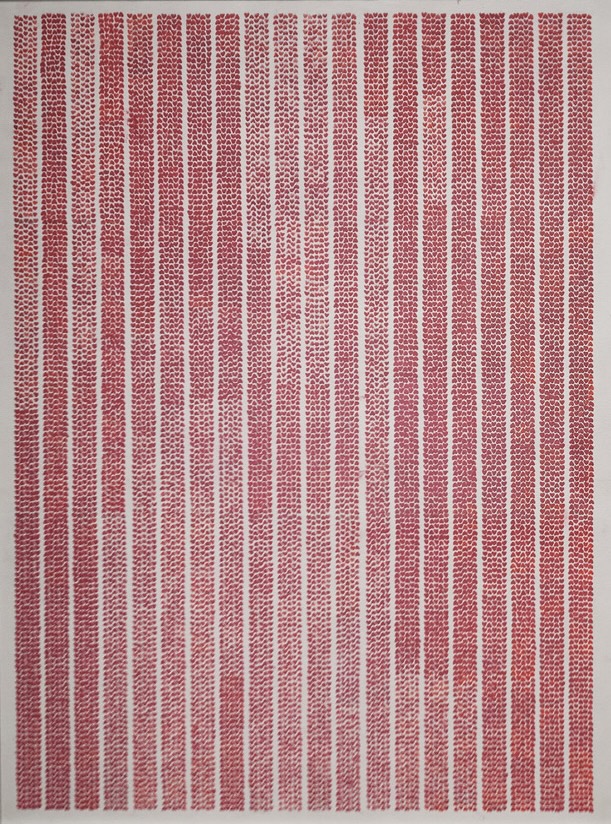

Burnt Hearts, 2017 (set of 2)
Gun powder extracted from matchsticks on paper | 56 x 76 cm (each)

Material Matters, 2017
Gunpowder (extracted from matchsticks), extracted matchsticks, and glass box | 60.96 × 30.48 × 76.20 cm | 10 × 10 × 10 cm (glass box)

Kamal Raj, 2017
Gunpowder (extracted from matchsticks) on matchbox labels | 76 × 56 cm
Birender likes to explore materials and he deconstructed the common match box by scrapping out the gun powder and used the material to paint the surface to create a tension of violence.It was literally playing with fire. He conceptually chooses a match box with a lotus symbol and painted it with gun powder to represent how the lotus was appropriated as the sacred flower become a party symbol.
–Suresh Jayaram
PRESS :
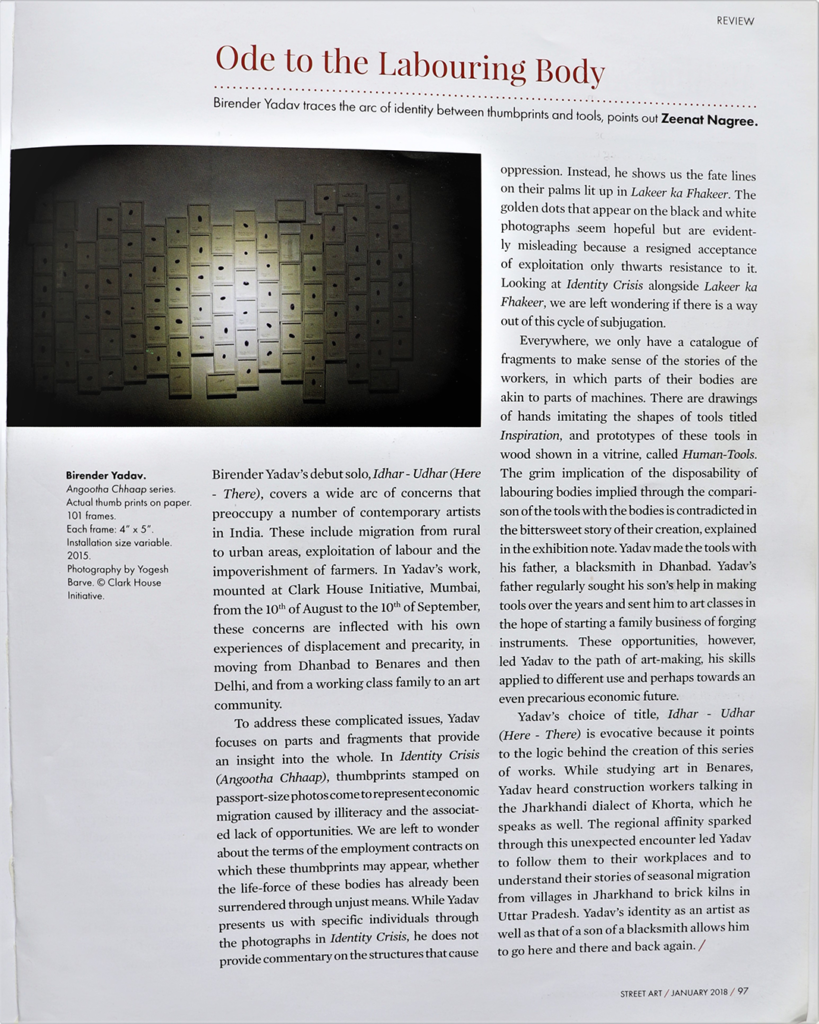
Art India | Jan 2018