Mumbai Art Room’s second curatorial lab in partnership with Pro Helvetia – Swiss Art Council is pleased to host ‘कृपया ध्यान दीिजए | Allow me a letter’, an exhibition by Swiss based curator Bénédicte le Pimpec.
The exhibition features an installation by Delhi based artist Birender Kumar Yadav, a film by French based artist Pierre Michelon and a workshop by Aqui Thami, a Bombay based artist and activist. A letter, addressed, anonymous, threatening or filled with love, is also mute, inspired, exalted, or repeated, whether public or secret. As a formal character of a curved alphabet in a sonic frequency, out-loud or inaudible, it sometimes ends up on the wall of an official building, in the mouth of polyglots, or sought after in Colaba, the hip neighbourhood of south Bombay.
Using several languages (Bengali, Hindi, English, French), this exhibition occupies the Mumbai Art Room venue and spills over into the surrounding public place. It presupposes that discourses, as forms of social action representing society and culture, are ideologically and historically guided, and that there is never any neutrality, be it of language or its use. Birender Kumar Yadav copies the sentence “Government work is god’s work” seen on the pediment of the Vidhana Soudha building, hub of power and legislative seat of the state of Karnataka, and installs it at the entrance to the exhibition. In so doing, he changes the referent and, by a simple shift, alters the relation between this sentence and its installation context. Unity/Diversity, the artist’s second piece, is a hijacked flag of the State of Karnataka, which has claimed its own flag since 2018. This flag refers directly to the rise of forms of regionalism in India, and the complex socio-cultural situation of a federal state with
more than 2,000 languages and dialects.
On the other hand, Pierre Michelon’s film Tepantar finds in Bengal an ideal outward point for talking about France “with a small f”. The voice of the French journalist and novelist Guy Hocquenghem is mixed with that of Marguerite Duras in the film India Song, to the cackling of chicks in the Tepantar theatre and the voice of gay activist Michel Chomarat. The whole thing collides in the mouth of Sudipta Mitra Datta, Bengali translator of the passages from La beauté du Métis, réflexion d’un francophobe (1978) by Hocquenghem. Tepantar is not so much a criticism of a country as a complex line of thinking about the power structures inherent in any nation, and proposes a dream of statelessness.
In this context, the artist and activist Aqui Thami proposes Bombay Signs, a workshop offering a children’s group a chance to explore the neighbourhood surrounding the exhibition venue, to reclaim the signs scattered in the public place. This workshop will take place on March 16th for a mixed group of children from Dharavi and Colaba’s local government school.
This Curatorial Lab and exhibition has been supported by Pro Helvetia New Delhi – Swiss Arts Council.
Government Work is God’s Work, 2019
LED Signboard | 274.3 × 30.5 × 15.2 cm
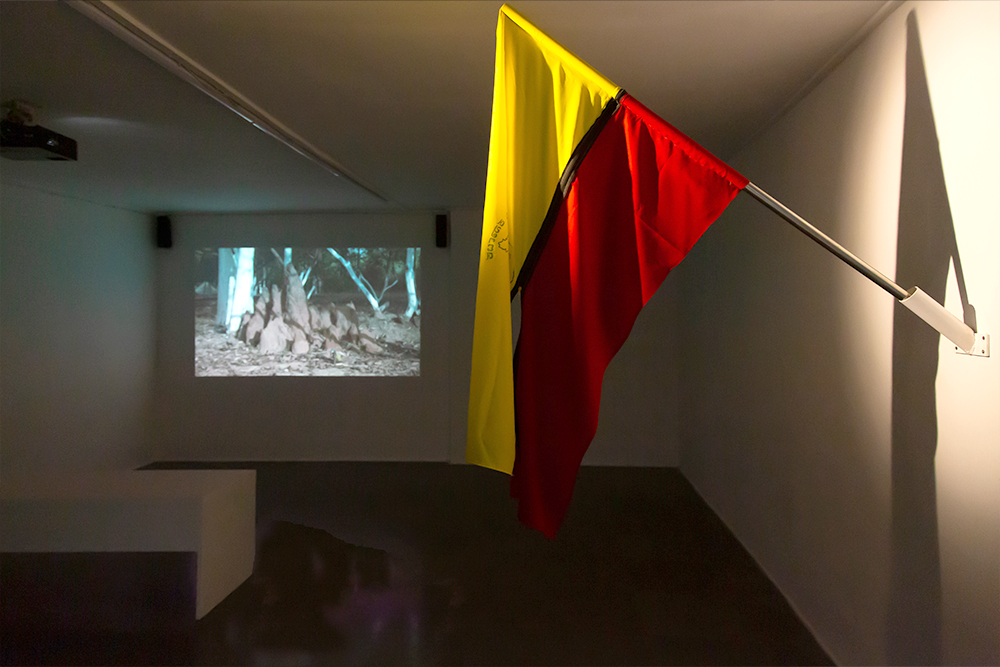
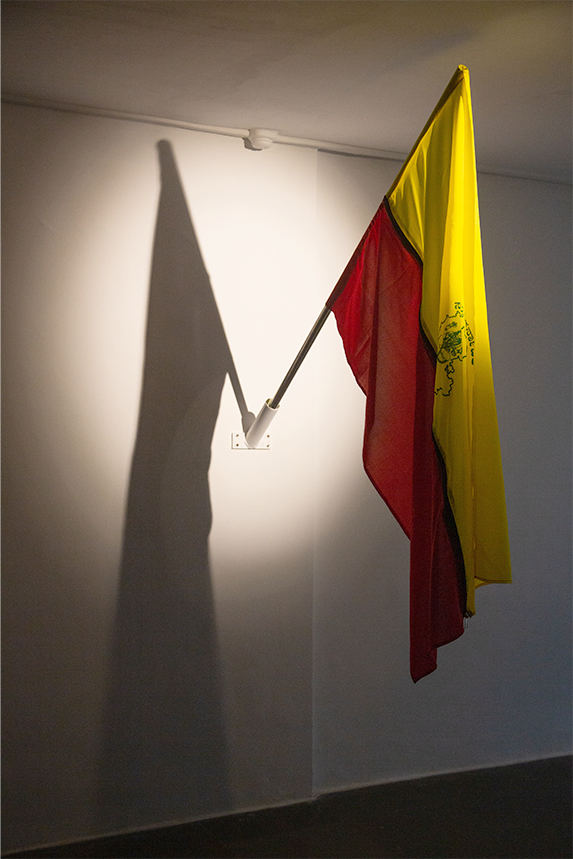
Unity/Diversity, 2017
Karnataka regional flag and zipper | 60.96 × 91.44 cm
The city of Bengaluru was a new site for Birender Yadav at the art residency at One Shanthi Road,the most common objects and symbols became a trigger to investigate. was a take on the popular red and yellow Karnataka flag and the growing regional nationalism in the state. The colors of the flag represent turmeric yellow and Kum Kum red. It emerged in the context fight for Kannada pride and identity by locals to safe guard their rights. Local Kannada groups have used it extensively to celebrate Kannada Rajotsava.
Interestingly, we see the use and misuse of Karnataka flag, we also see them on many corporate buildings to protect them from vandalism during local agitations for the Cauvery water. It has become a “ Kavacha”-protective armor in times of crisis. Birender had used a zipper between the two colors to physically separate and connect the two halves of the flag.
-Suresh Jayaram