LEE Ungno is widely known for his ink abstraction, blending Asian calligraphic traditions with abstract painting. He created dozens of enigmatic drawings in France between 1977 and 1979. These drawings, rendered in ink on French newspaper pages, are known to explore meanings embedded in the strokes of ideographic Chinese characters (表意), the hexagrams of the Yijing (卦), and human-like forms. One particularly distinctive and recurring motif is that of a dancing figure in the form of a bird. With both arms fully extended into the air, the figure captures the movement of dance. It evokes wings, suggesting not a human but a being equipped with a beak and wings, hinting at another life-form. Seen differently, the conical-hatted dancer may resemble an Asian shaman or an African ritual priest; upon closer reflection, it may even evoke the “Angel of History.” At times, it appears to ascend, or descend, from the surface of a newspaper inscribed with human activity. The form left by the black ink unmistakably embodies the mystery of ontological cosmology (“COSMO”), “ASIA” as a non-Western sensibility, and “PEOPLE” as a form of existence that extends beyond the human.
The 2026 ACC Thematic Exhibition, “COSMO, ASIA, PEOPLE,” adopts this image by LEE Ungno as its prologue, accompanied by the subtitle: “Reinventing People in a Planetary Age.” In an era when our very survival is at risk and it is difficult to imagine a different future, this exhibition adopts three symbolic keywords as its key terms to envision new subjects who can live in the present while dreaming of alternative possibilities. COSMO, ASIA, PEOPLE. By connecting the mystery and harmony of cosmology, the lives of non-Western subjects, and the possibilities of “people” beyond anthropocentric thinking, the exhibition seeks to defamiliarize the now-familiar future and awaken new ways of imagining it.
For this exhibition, world-renowned Slovenian philosopher Slavoj Žižek contributed a compelling text on “possible futures” and “imagining otherwise,” proposing the following: “Doesn’t ‘radicalized pragmatism’ feel somewhat inadequate in an era where our very survival is at stake? Is it not clear that what we need is, quite literally, a kind of ‘mad’ social action—one that would dismantle many of the fundamental assumptions sustaining our normal everyday life? We must prepare ourselves for an unknown state of emergency.”

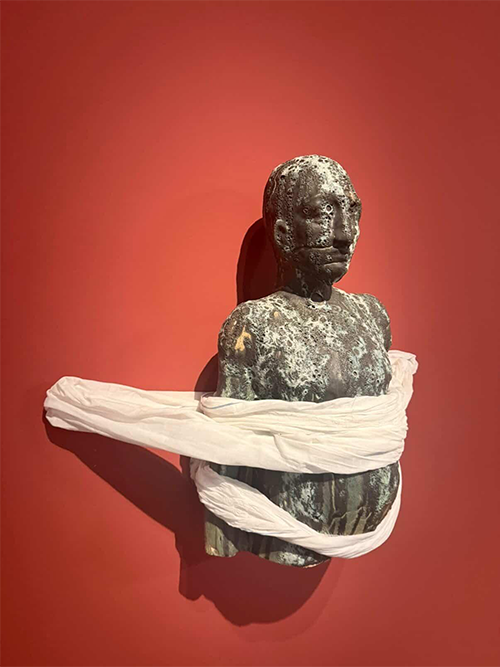

What remains after burn (2025)
Stoneware and cloth | 60 cm × 45 cm × 25 cm